
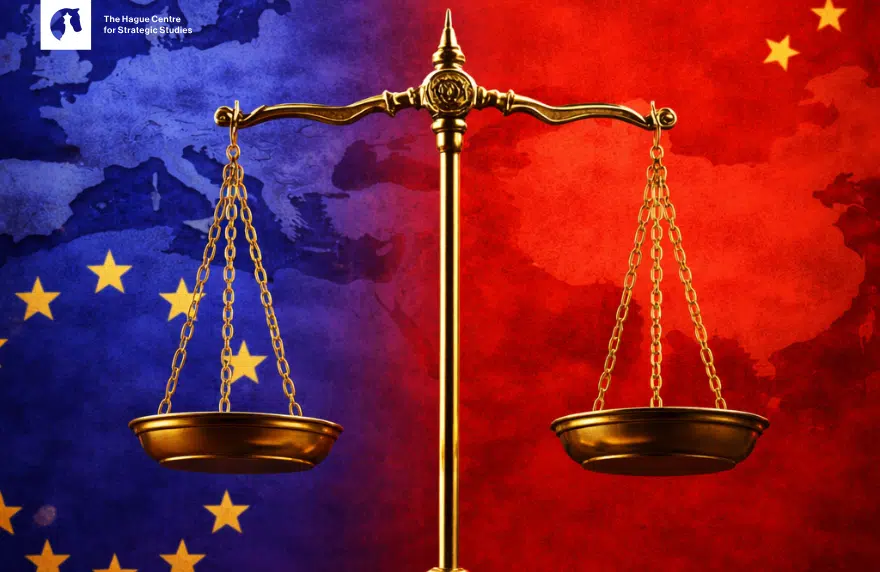
China is increasingly reshaping the international legal order not by overturning it, but by strategically working through it. A new HCSS report by Benedetta Girardi, Anna Hoefnagels, and Berend Kwak shows how Beijing uses “lawfare” to reinterpret norms, build parallel institutions, and gradually expand its influence across global governance.
The report introduces a five-stage framework to understand how rising powers translate legal strategy into systemic change, ranging from delegitimising existing norms to building international support for alternative legal arrangements. China’s approach is most advanced in trade governance, where Belt and Road-linked dispute resolution mechanisms are already providing a credible alternative to Western legal fora. In maritime security and technology governance, progress is more uneven, but still strategically disruptive.
Rather than acting as a clear revisionist power, China operates within existing frameworks while reshaping their interpretation and application. This creates structural asymmetries for Europe, where law functions as a constraint, while Beijing increasingly treats it as an instrument of competition.
Lead author Benedetta Girardi notes:
“China is not rejecting the rules-based order outright. It is reinterpreting and operationalising it in ways that increase its strategic flexibility and long-term influence.”
“Its unconventional treatment of legal institutions allows China to weaken the system without dismantling it,” adds Berend Kwak.
The report warns that Chinese lawfare can exploit fragmentation within the EU, create regulatory dilemmas for European companies, and erode the Union’s normative influence over time.
To respond, the authors call for a more strategic European approach: strengthening legal diplomacy, investing in competitive dispute resolution mechanisms, coordinating responses to extraterritorial legislation, prioritising international standard-setting, and embedding legal cooperation in external partnerships.
“Europe cannot afford to treat legal governance as neutral terrain,” Girardi emphasises. “Policymakers must actively shape the rules, institutions, and standards that will define the next phase of geopolitical competition.”
Authors: Benedetta Girardi, Anna Hoefnagels and Berend Kwak.
Contributors: Marit Weurding and Nora Nijboer.
Cover image: AI-generated with OpenAI’s ChatGPT.
With acknowledgment to Tim Sweijs for his contributions to the development and refinement of the research project.
The research for and production of this report has been conducted within the PROGRESS research framework agreement. Responsibility for the contents and for the opinions expressed, rests solely with the authors and does not constitute, not should be construed as, an endorsement by the Netherlands Ministries of Foreign Affairs and Defence.
Experts

Related Content