HCSS
  • News
    • BNR | De Strateeg
    • Columns
    • Events
    • HCSS Newsletter
    • Podcasts
  • Publications
    • Publications
      • All Projects
      • All Publications
    • Geopolitics & Governance
      • Transatlantic Relations
      • Russia & Eurasia
      • Europe in the Indo-Pacific
      • AI in the Military Domain
      • PROGRESS / Strategic Monitor
      • Socio-Political Instability Survey
    • Economics & Technology
      • Emerging Technologies
      • Critical Materials
      • Energy Security
    • Defence & Security
      • On Future War
      • Deterrence and Arms Control
      • Hybrid Threats
      • Cyber Security
    • Society & Resilience
      • Nationale Veiligheid en Weerbaarheid
      • Publieksmonitor Maatschappelijke Stabiliteit
      • Transnational Organised Crime
      • Strategic Monitor Dutch Police
    • Climate, Water & Food
      • Climate Security
      • Water, Peace & Security (WPS)
      • Food Security
  • Dashboards
    • Dashboards
      • All Tools
        • GINA
        • SARA
    • Geopolitics & Governance
      • DFRI
      • GINA | Diplomatic
      • GINA | Information
      • CLARIS
    • Economics & Technology
      • DOMINO
      • GATRI
      • GINA | Economic
      • Cyber Arms Watch
      • Cyber Comparator
      • Cyber Norms Observatory
      • Cyber Transparency
    • Defence & Security
      • GINA | Military
      • Nuclear Timeline
    • Society & Resilience
      • DAMON
    • Climate, Water & Food
      • Agrifood Monitor
      • CARMEN
      • CRM Dashboard
  • Leadership Practice
    • HCSS Leadership Practice
    • HCSS Boardroom
    • Strategic Negotiations Course
    • Serious Gaming
    • IDCSS | Indo-Dutch Cyber Security School
    • SANCS | Southern Africa-Netherlands Cyber Security School
  • About HCSS
    • Contact Us
    • HCSS Datalab
    • Our People
    • Funding & Transparency
    • Internship Programme
    • Press & Media Inquiries
    • Studio HCSS
    • Working at HCSS
    • Global Futures Foundation
  • Click to open the search input field Click to open the search input field Search
  • Menu Menu

News

New Report: Between the Berlaymont and the Glass Palace: The relative roles of the European Union and NATO in European defence

March 31, 2026

Europe’s defence landscape is complex, and the relationship between the European Union and NATO is a prime example. Though only five kilometres apart in Brussels, the EU and NATO often appear worlds apart in practice. This new HCSS report by Davis Ellison and Daniel Fiott offers a clear-eyed assessment of this relationship and a roadmap for improvement.  

Persistent political tensions, overlapping memberships, and entrenched institutional suspicion have historically constrained cooperation between these core European security actors. The second Trump presidency, Brexit, and ongoing regional disputes – most notably involving Türkiye and Cyprus – have compounded these challenges. 

Yet, European states continue to invest heavily in both organisations. Lead author Davis Ellision notes:

“Despite tensions, EU and NATO remain the indispensable frameworks for European security. Cooperation and competition coexist, but neither can be replaced.”

Download PDF

The report identifies key areas for strengthening EU-NATO cooperation: 

  1. Reform of the Berlin Plus Agreement to streamline EU access to NATO assets. 
  1. Closer political coordination in Brussels, particularly between the EU’s Political and Security Committee and NATO’s North Atlantic Council. 
  1. Reconceptualising European defence scenarios to better align strategic planning across institutions. 
  1. Greater alignment of defence planning to reduce duplication and enhance operational readiness. 

Crucially, improving institutional cooperation also requires addressing Europe’s dependence on the United States. While some capitals aim to reduce reliance on American forces and defence industry, this will require careful coordination and at least tacit approval from Washington. 

The study highlights that European security is inherently regional: both NATO and the EU operate in service of European stability. Germany and France, in particular, play leading roles in navigating the complex web of institutional relationships, with other states such as the Netherlands actively supporting reforms. 

Daniel Fiott, co-author, emphasises:

“The moment is ripe for reform. European capitals must seize this opportunity to build a more self-sufficient, resilient, and credible security architecture within and alongside NATO.” 

The report provides a provisional menu of reforms for policymakers seeking to strengthen the EU’s role within NATO, improve institutional cooperation, and foster European strategic autonomy without jeopardising the transatlantic bond.

Download PDF

Authors: Davis Ellison and Daniel Fiott (Assistant Professor at the Centre for Security, Diplomacy and Strategy (CSDS) at the Vrije Universiteit Brussel (VUB), where he heads the Defence and Statecraft Programme)

Contributor: Noemie Jacq

Quality assurance: Paul Sinning

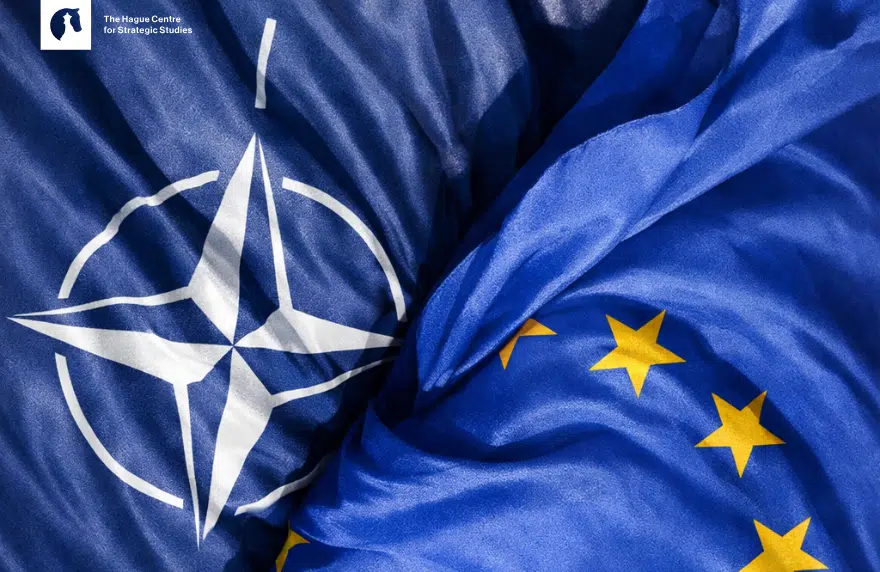
Cover image: AI-generated with OpenAI’s ChatGPT.

Prof. Dr Daniel Fiott is an Assistant Professor at the Centre for Security, Diplomacy and Strategy (CSDS) at the Vrije Universiteit Brussel (VUB), where he heads the Defence and Statecraft Programme. He is also a Non-Resident Fellow at the Real Instituto Elcano in Madrid. His work focuses on European security and defence, with particular expertise in defence-industrial policy, military-technology strategy and EU security and defence cooperation.

The research for and production of this report has been conducted within the PROGRESS research framework agreement. Responsibility for the contents and for the opinions expressed, rests solely with the lead authors and does not constitute, nor should be construed as, an endorsement by the Netherlands Ministries of Foreign Affairs and Defence.

  • Share on Facebook
  • Share on X
  • Share on WhatsApp
  • Share on LinkedIn
  • Share by Mail

Experts

Davis Ellison

Related News

Related Content

Assessing Europe’s Resilience and Preparedness in an Era of Strategic Risks   
Position paper | Scaling Up the European Defence Industry
Germany’s Zeitenwende and the consequences for German-Dutch defence cooperation

Office Address

  • The Hague Centre for Strategic Studies
  • Lange Voorhout 1
  • 2514 EA The Hague
  • The Netherlands

Contact Us

  • Telephone: +31(70) 318 48 40
  • E-mail: info@hcss.nl
  • IBAN NL10INGB0666328730
  • BIC INGBNL2A
  • VAT NL.8101.32.436.B01
  • Contact

Legal & Privacy

  • Disclaimer & Privacy
  • Algemene Voorwaarden 2024 (NL) 
  • Terms & Conditions 2024 (ENG) 
  • Algemene Voorwaarden 2026 (NL) 
  • Terns & Conditions 2026 (EN) 
  • Coordinated Vulnerability Disclosure
  • Ethical Standards
  • Manual for Responsible Use of AI

Follow us

© The Hague Centre for Strategic Studies
    Link to: De Tafel van Mars | Luister vanaf 6 april naar de nieuwe podcast van Trouw en HCSS Link to: De Tafel van Mars | Luister vanaf 6 april naar de nieuwe podcast van Trouw en HCSS De Tafel van Mars | Luister vanaf 6 april naar de nieuwe podcast van Trouw en... Link to: Dissertation Maarten Vonk | From Inference to Influence: Applying Causal Game Theory to Complex Security Environments Link to: Dissertation Maarten Vonk | From Inference to Influence: Applying Causal Game Theory to Complex Security Environments Dissertation Maarten Vonk | From Inference to Influence: Applying Causal Game...
    Scroll to top Scroll to top Scroll to top

    GDPR Consent

    Your privacy is important to us. Here you can set which consent you are allowing us with regards to the collection of general information, the placing of cookies of the collection of personal information. You can click 'Forget my settings' at the bottom of this form to revoke all given consents.

    Privacy policy | Close
    Settings

    GDPR Consent Settings

    Your privacy is important to us. Here you can set which consent you are allowing us with regards to the collection of general information, the placing of cookies of the collection of personal information. You can click 'Forget my settings' at the bottom of this form to revoke all given consents.

    Website statistics collect anonymized information about how the site is used. This information is used to optimize the website and to ensure an optimal user experience.

    View details

    Functional cookies are used to ensure the website works properly and are neccessary to make the site function. These cookies do not collect any personal data.  

    View details
    Forget my settings Deleted!