
In I/O Magazine, HCSS expert Frank Bekkers argues that Europe’s security challenges demand a fundamental overhaul of ICT systems. As hybrid threats intensify and reliance on external technologies becomes riskier, achieving strategic autonomy is increasingly urgent. This requires faster innovation cycles, more flexible procurement, and closer collaboration between public, private, and academic actors, with researchers working directly alongside end-users to deliver practical solutions at speed.
The European security situation requires radical changes in all domains of security-related ICT systems. Conversely, all ICT systems are security-related. In the realm of defence ICT systems, a lot of work has to be done. What are the main challenges, what do these mean for ICT researchers in knowledge institutes, and what is already happening there?
The EU is tangled up in a hybrid war with Russia. The Greenland crisis has shown that the reliance on American software systems poses a giant security liability. Apart from that, Europe must be on the alert for Chinese industrial and military espionage. All things considered, the ICT challenges are enormous, time is limited, and even increased budgets are insufficient. Frank Bekkers, director of the security programme at The Hague Center for Strategic Studies: ‘It requires a Herculean effort to adapt all systems. These range from “grey” ministerial, civil-military management systems to “green” command and control systems and embedded software in all kinds of military hardware. Boundaries between domains have faded; ICT systems permeate everything.’
Strategic autonomy
Bekkers indicates that our addiction to American military systems was, in fact, already baked into the post-WWII Marshall support. ‘And within NATO, certain domains, such as strategic intelligence and command and control systems, were entirely left to the Americans. Add the fact that software platforms
have a buy-in aspect that makes it hard to switch after initial procurement.’ To achieve European strategic autonomy, we have to build European systems, Bekkers states. ‘We have the knowledge and the industrial capabilities to do so, but to create the necessary mass and operational strength will require time, resolution and enormous budgets.’
However, according to Bekkers, business as usual will not do. ‘Article 346 of the Treaty on the Functioning of the European Union (TFEU) allows EU Member States to derogate from standard EU public procurement rules to protect essential security interests. Freedom of partner selection is already sufficiently covered by that. The EU’s policies to diversify sectors in which we have to become less dependent on the Americans are on the right track, but the actual, timely execution is hardly feasible. The procurement practice and the collaboration between clients and contractors, including academic researchers, will have to change. There is no time for the lengthy establishment of fixed specifications, followed by prolonged public procurement procedures of the traditional model. Flexibility and speed are essential. That requires a closer collaboration between public and private parties.’
End-user focused mindset
The new situation requires researchers to become more actively involved in their clients’ use cases, says Bekkers, in an interaction sustained throughout the product’s lifecycle. ‘The innovation cycle of drone technology is the perfect example. Deliverables are not expected within a couple of years, but within weeks. In peacetime, demand for military capabilities can seem abstract. Now it is much more concrete; a close back-and-forth between users and researchers is needed, and a speedy up-and-down cycle through all technology readiness levels is required. Solutions can be quick and dirty; practical combat deployment will prove the solution’s value and the tweaks that might be necessary. This approach asks for a different, end-user-focused mindset. Although this example regards extremely practical applications, it also touches fundamental science. Apart from purely curiosity-driven research, there should also be more room for targeted fundamental research towards breakthroughs in various fields to attain certain much-needed deliverables.’
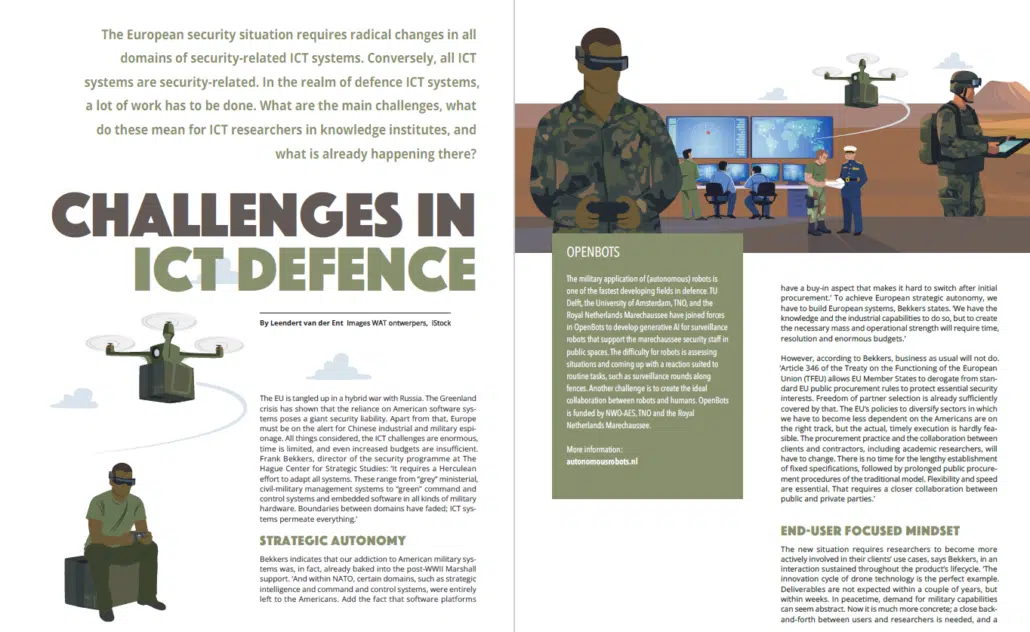
Source: I/O Magazine, Volume 23 April 2026, No. 1, by Leendert van der Ent
About I/O Magazine
ICT-Reseach Platform Netherlands (IPN) is a platform with a board, members and supporters. The platform is supported by The Dutch Science Council (NWO).
I/O magazine is the magazine of IPN and sent to our subscribers twice a year free of charge.
Experts

Related Content