How do foreign actors actually manipulate elections, as seen in Moldova and Armenia? And how can democracies counter that interference without compromising the freedoms they are trying to protect?
This conference, organised by the Clingendael Institute together with The Hague Centre for Strategic Studies, seeks to understand the rapidly evolving landscape of election interference and Foreign Information Manipulation and Interference (FIMI). Experiences from Moldova, Armenia, and Bosnia and Herzegovina illustrate how foreign actors exploit political divisions, digital platforms, and institutional vulnerabilities. These cases also expose difficult policy dilemmas: how can governments counter malign interference without undermining freedom of expression, political pluralism, or public trust?
During the event, we will examine the challenges that this brings to democratic resilience and the integrity of the electoral processes by bringing together policymakers, researchers and practitioners. The panels will compare national experiences and identify lessons for strengthening the European Union’s capacity to anticipate, prevent, and respond to election interference and FIMI.
Through two focused panels, we aim understand how election interference works in practice, drawing from recent experiences in Moldova and Armenia, as well as explore the difficult policy dilemmas that are involved in countering FIMI.
Event Details:
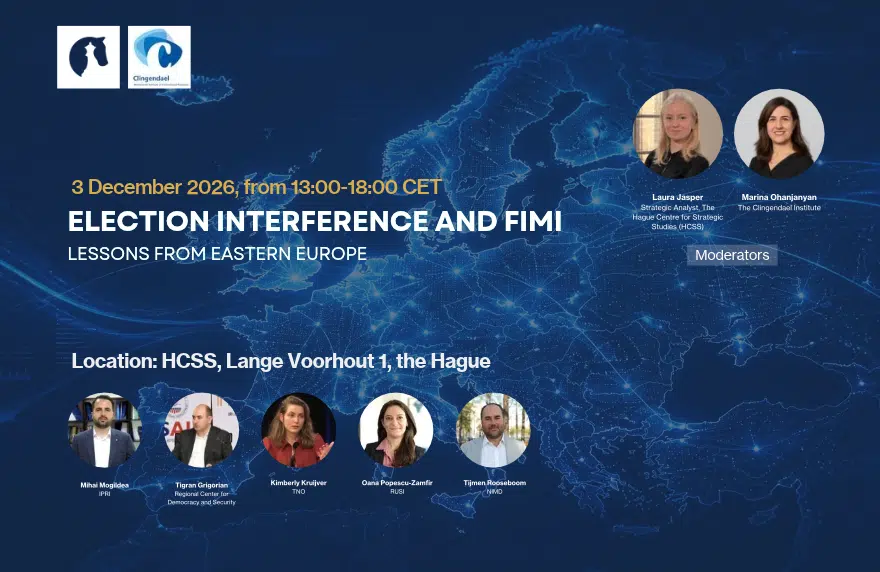
- Date: 3 December 2026
- Time: 13.00-18.00 CET
- Location: The Hague Centre for Strategic Studies in The Hague
Preliminary Programme
13.00 – 13.30 | Registration and Coffee
13.30 – 14.00 | Opening Remarks
- Welcome by Paul Sinning, CEO, HCSS
- Introduction to Clingendael report on FIMI by Marina Ohanjanyan, Coordinator Russia and Eastern Europe Centre and Senior Research Fellow, Clingendael Institute
- Keynote by Pyke Polderman, Cluster Coordinator for Hybrid Threats and Economic Security at the Ministry of Foreign Affairs
14.00 – 15.15 | Panel 1: Election Interference in Practice
This panel examines how election interference and FIMI operate in practice, drawing on recent experiences from Moldova and Armenia. It explores the tactics, actors, and vulnerabilities involved, as well as how actors sought to mitigate interference.
- Mihai Mogildea, Deputy Director, Institute for European Policies and Reforms (IPRI)
- Tigran Grigorian, Director, Regional Center for Democracy and Security
- Kimberley Kruijver, Researcher Security and Defence, TNO
Moderator: Laura Jasper, Programme Coordinator and Strategic Analyst, HCSS
15.15 – 15.45 | Break
15.45 – 17.00 | Panel 2: Policy dilemmas in countering FIMI – Balancing democracy and security
This panel explores the difficult policy dilemmas involved in countering FIMI, particularly the tension between protecting democratic processes and safeguarding fundamental rights and freedoms.
- Oana Popescu-Zamfir, Senior Fellow European Security, RUSI
- Tijmen Rooseboom, Executive Director, Netherlands Institute for Multiparty Democracy (NIMD)
Moderator: Marina Ohanjanyan, Clingendael Institute
17.00 – 17.15 | Concluding Remarks
- Drs. J.M.D. (Hans) van Leeuwe, Head of Counter Hybrid Unit, Ministry of Defence
17.15 | Informal Reception
Experts

Related Content