
HCSS
  • News
    • BNR | De Strateeg
    • Columns
    • Events
    • HCSS Newsletter
    • Podcasts
  • Publications
    • Publications
      • All Projects
      • All Publications
    • Geopolitics & Governance
      • Transatlantic Relations
      • Russia & Eurasia
      • Europe in the Indo-Pacific
      • AI in the Military Domain
      • PROGRESS / Strategic Monitor
    • Economics & Technology
      • Emerging Technologies
      • Critical Materials
      • Energy Security
    • Defence & Security
      • On Future War
      • Deterrence and Arms Control
      • Hybrid Threats
      • Cyber Security
    • Society & Resilience
      • Nationale Veiligheid en Weerbaarheid
      • Publieksmonitor Maatschappelijke Stabiliteit
      • Transnational Organised Crime
      • Strategic Monitor Dutch Police
    • Climate, Water & Food
      • Climate Security
      • Water, Peace & Security (WPS)
      • International Military Council on Climate and Security (IMCCS)
      • Food Security
  • Dashboards
    • Dashboards
      • All Tools
        • GINA
        • SARA
        • GATRI
        • DOMINO
    • Geopolitics & Governance
      • Diplomatic Networks
      • News Networks
      • Dutch Foreign Relations
      • Chinese Hybrid Threats
    • Economics & Technology
      • Economic Networks
      • Economic Risk
      • Critical Materials Supply Chains
      • Critical Materials Map
      • Critical Materials Pricing
      • Cyber Arms Watch
    • Defence & Security
      • Military Networks
      • Nuclear Timeline
    • Society & Resilience
      • Conflict Monitor
    • Climate, Water & Food
      • Agrifood Monitor
  • Leadership Practice
    • HCSS Leadership Practice
    • HCSS Boardroom
    • Strategic Negotiations Course
    • Serious Gaming
    • IDCSS | Indo-Dutch Cyber Security School
    • SANCS | Southern Africa-Netherlands Cyber Security School
  • About HCSS
    • Contact Us
    • HCSS Datalab
    • Our People
    • Funding & Transparency
    • Internship Programme
    • Press & Media Inquiries
    • Studio HCSS
    • Working at HCSS
    • Global Futures Foundation
  • Click to open the search input field Click to open the search input field Search
  • Menu Menu

News

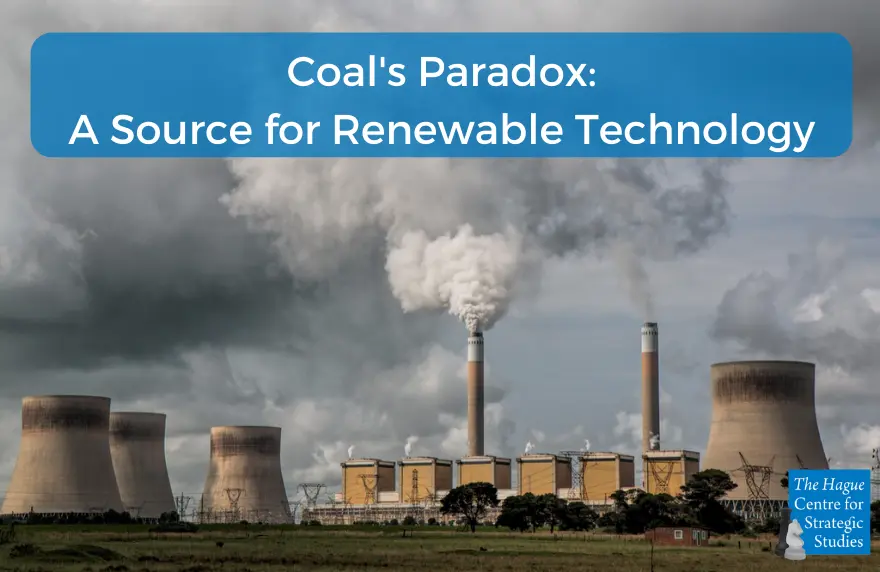
New snapshot: Coal’s Paradox: A Source for Renewable Technology

April 23, 2020

New snapshot by assistant analyst Dylan Browne-Wilkinson out now! 

Download here.

While most EU member states have achieved a reduction in carbon emissions, the Netherlands has seen an increase from 1990 levels. Despite pledging to reduce its carbon footprint, the country continues to have a heavy reliance on coal to support the high energy needs of its growing population. In order to reduce the environmental impact of coal usage, novel approaches to coal byproducts may offer cleaner solutions for generating power. One promising route is through the use of coal fire ash (CFA), which is produced during the coal firing process. CFA is normally treated as a waste product and disposed of, but it has also been found to be a source of rare-earth elements, which are valuable components of numerous clean energy technologies. Extracting these elements extends coal’s life cycle and is less damaging to the environment than mineral ore mining. It also reduces reliance on importing rare-earth elements from China, the world’s largest producer of them.

One of these rare-earth elements, Vanadium, can be used to make a type of redox flow batteries called Vanadium Flow Batteries (VFBs). VFBs are a long-lasting and sustainable energy source, as the Vanadium electrolyte does not degrade and can be reused. Compared to Lithium Batteries (LiBs), which are currently the most commonly used type of battery, VFBs have a longer lifespan, can undergo more cycles, have a greater depth of discharge, and are more powerful, only lagging behind LiBs in regard to density and energy efficiency. Given these qualities, VFBs are uniquely applicable as utility-scale batteries, particularly in contexts such as smart cities.

In contrast to the way cities run now, smart cities will more efficiently distribute electricity using systems that are better able to balance energy supply and demand. Software-enabled VFBs can be incorporated into the networks of smart cities to manage electricity by recirculating it through methods such as bidirectional charging. This reduces the peak load of electricity demand and allows for the introduction of various-renewable energy into the grid. Thus, the utilization of VFBs can reduce carbon emissions by allowing for more effective energy usage as well as by making use of a former waste product to help offset the negative environmental impact of coal-fired power. Therefore, harvesting CFA for rare-earth elements like Vanadium and implementing them into systems like VFBs is an important step toward a more energy-efficient future.

Download the snapshot here.

  • Share on Facebook
  • Share on X
  • Share on WhatsApp
  • Share on LinkedIn
  • Share by Mail

Experts

Patrick Bolder

Related News

Related Content

Coal’s Paradox: A Source for Renewable Technology
New snapshot: India’s Strategy in the Shanghai Cooperation Organisation
New snapshot: COVID-19 and world peace: An overture to a new era or business as usual?

Office Address

  • The Hague Centre for Strategic Studies
  • Lange Voorhout 1
  • 2514 EA The Hague
  • The Netherlands

Contact Us

  • Telephone: +31(70) 318 48 40
  • E-mail: info@hcss.nl
  • IBAN NL10INGB0666328730
  • BIC INGBNL2A
  • VAT NL.8101.32.436.B01
  • Contact

Legal & Privacy

  • Disclaimer & Privacy
  • Algemene Voorwaarden 2024 (NL) 
  • Terms & Conditions 2024 (ENG) 
  • Algemene Voorwaarden 2026 (NL) 
  • Terns & Conditions 2026 (EN) 
  • Coordinated Vulnerability Disclosure
  • Ethical Standards
  • Manual for Responsible Use of AI

Follow us

© The Hague Centre for Strategic Studies
    Link to: Lucia van Geuns over de historisch lage olieprijs bij BNR De Wereld Link to: Lucia van Geuns over de historisch lage olieprijs bij BNR De Wereld Lucia van Geuns over de historisch lage olieprijs bij BNR De Wereld Link to: Column: China gebruikt westerse zwakte om eigen positie te verstevigen Link to: Column: China gebruikt westerse zwakte om eigen positie te verstevigen Column: China gebruikt westerse zwakte om eigen positie te verstevigen
    Scroll to top Scroll to top Scroll to top

    GDPR Consent

    Your privacy is important to us. Here you can set which consent you are allowing us with regards to the collection of general information, the placing of cookies of the collection of personal information. You can click 'Forget my settings' at the bottom of this form to revoke all given consents.

    Privacy policy | Close
    Settings

    GDPR Consent Settings

    Your privacy is important to us. Here you can set which consent you are allowing us with regards to the collection of general information, the placing of cookies of the collection of personal information. You can click 'Forget my settings' at the bottom of this form to revoke all given consents.

    Website statistics collect anonymized information about how the site is used. This information is used to optimize the website and to ensure an optimal user experience.

    View details

    Functional cookies are used to ensure the website works properly and are neccessary to make the site function. These cookies do not collect any personal data.  

    View details
    Forget my settings Deleted!