Research

A new report by HCSS and the China Knowledge Network (CKN), Beyond Borders: Chinese Use of Foreign Interference Tactics in Dutch Strategic Industries, finds that Chinese foreign interference in the Netherlands should be understood not as a series of isolated incidents, but as a systemic and long-term challenge affecting the country’s strategic autonomy, economic resilience, and national security.
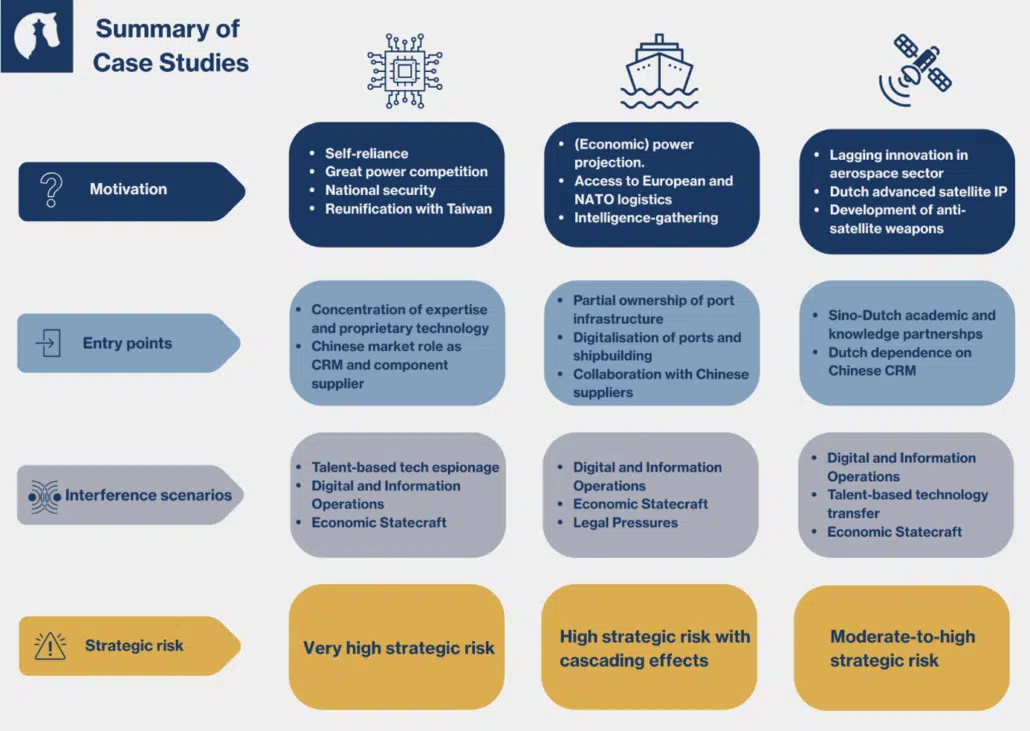
Authored by Strategic Analysts Benedetta Girardi and Hans Horan, the report examines how Chinese actors use a broad range of interference tactics (including cyber espionage, talent recruitment, economic leverage, information operations, and supply-chain influence) to target three strategically important Dutch sectors: semiconductors, maritime industries, and aerospace.
The research identifies the semiconductor sector as facing the highest strategic risk, given its central role in global technology supply chains and the unique position of Dutch companies in advanced chip manufacturing. The maritime sector is assessed as high risk due to its openness, global interconnectedness, and importance to trade and NATO logistics. The aerospace sector faces moderate-to-high risks linked to technology acquisition and dual-use innovation.
Across all three sectors, the report identifies three recurring patterns: Chinese interference exploits openness, digitalisation, and economic interdependence; interference activities are coordinated as part of broader strategic objectives; and fragmented governance hampers effective detection and response.
“Chinese foreign interference in Dutch strategic industries is best understood as a systemic challenge that unfolds over time,” says lead author Benedetta Girardi. “The cumulative impact of technology transfer, knowledge acquisition, and strategic dependencies can gradually erode the Netherlands’ technological edge and strategic autonomy if left unaddressed.”
To strengthen resilience, the report recommends establishing a national coordination and intelligence-sharing architecture on foreign interference, implementing risk-based security standards across strategic sectors, creating a public-private resilience fund, enhancing transparency and international coordination, and pursuing a strategy of managed interdependence with China that combines engagement with safeguards and reciprocity.
The report concludes that the Netherlands must move beyond reactive measures and adopt a proactive, resilience-based approach to protecting its strategic industries while maintaining selective engagement with China.
Authors: Benedetta Girardi and Hans Horan
Contributor: Alexander Krabbendam
Quality Assurance: Tim Sweijs
See below the CKN Report Presentation – Chinese Use of Foreign Interference Tactics in Dutch Strategic Industries:


Related Content