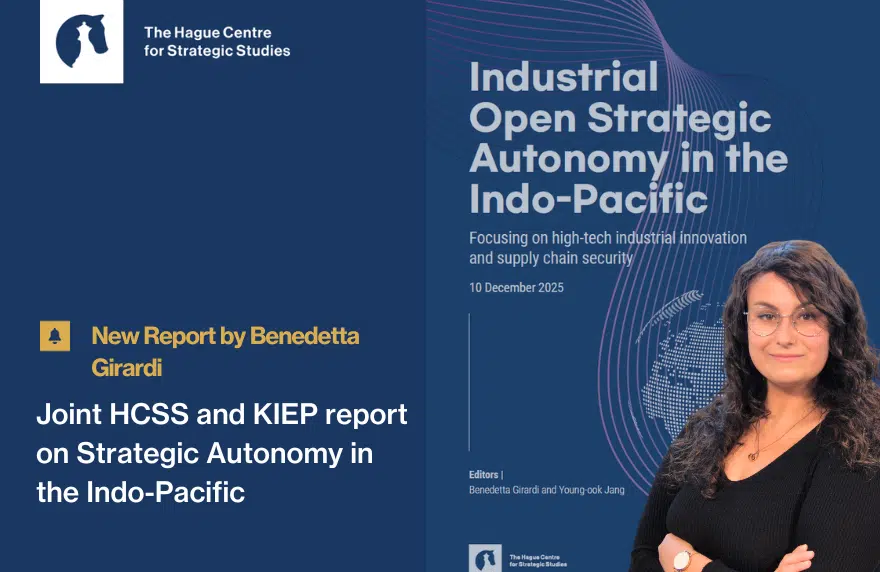
As geopolitical competition intensifies and economic interdependence becomes increasingly weaponized, countries across the Indo-Pacific and Europe are rethinking how to safeguard prosperity without retreating into protectionism. The new edited volume Industrial Open Strategic Autonomy in the Indo-Pacific: Focusing on High-Tech Industrial Innovation and Supply Chain Security, edited by Benedetta Girardi (HCSS) and Young-ook Jang (KIEP), examines how middle powers can reconcile openness with resilience in a rapidly fragmenting global economy.
Commissioned by the Dutch Ministry of Foreign Affairs and the Ministry of Foreign Affairs of the Republic of Korea, the volume explores how South Korea and the Netherlands—two highly open, technologically advanced economies—can deepen cooperation to strengthen economic security while preserving an open, rules-based international order.
The edited volume argues that “open strategic autonomy” does not imply isolation or decoupling. Instead, it emphasizes selective cooperation, trusted partnerships, and joint investment in strategic capabilities. Drawing on contributions from leading experts, the volume is structured around two core pillars.
Part I analyses the policy foundations of economic security, including South Korea’s evolving economic security strategy, Europe’s approach to open strategic autonomy, and analytical tools such as Joris Vierhout’s Control Points Framework for identifying vulnerabilities and leverage in global value chains. Richard Ghiasy situates Dutch–Korean cooperation within the broader Indo-Pacific geopolitical landscape, highlighting the need for pragmatic coordination amid technological rivalry and supply-chain pressures.
Part II focuses on four critical technology domains that will shape future industrial competitiveness and security: AI semiconductors, quantum technologies, energy security, and critical raw materials for defence. Contributions by Irina Patrahau, Mayra van Houts and others show how joint R&D, standard-setting, diversified sourcing, and shared industrial strategies can reduce vulnerabilities while accelerating innovation.
The volume concludes that middle powers can play a decisive role in shaping the future global economic order—not by disengaging, but by aligning policies, pooling technological strengths, and building resilient, trusted partnerships across regions. In doing so, South Korea and the Netherlands offer a compelling model for advancing industrial innovation and supply-chain security in the Indo-Pacific and beyond.
Authors: Benedetta Girardi and Young-ook Jang
Partner institution: Korea Institute for International Economic Policy (KIEP)
This report was commissioned by the Ministry of Foreign Affairs of the Republic of Korea and the Dutch Ministry of Foreign Affairs. The conclusions and recommendations presented in this study are the result of independent research. Responsibility for the content rests with the authors and the authors alone.
© The Korea Institute for International Economic Policy. All rights reserved. No part of this report may be reproduced and/or published in any form by print, photo print, microfilm, or any other means without prior written permission from KIEP. All images are subject to the licenses of their respective owners.
Experts

Related Content