HCSS
  • News
    • BNR | De Strateeg
    • Columns
    • Events
    • HCSS Newsletter
    • Podcasts
  • Publications
    • Publications
      • All Projects
      • All Publications
    • Geopolitics & Governance
      • Transatlantic Relations
      • Russia & Eurasia
      • Europe in the Indo-Pacific
      • AI in the Military Domain
      • PROGRESS / Strategic Monitor
    • Economics & Technology
      • Emerging Technologies
      • Critical Materials
      • Energy Security
    • Defence & Security
      • On Future War
      • Deterrence and Arms Control
      • Hybrid Threats
      • Cyber Security
    • Society & Resilience
      • Nationale Veiligheid en Weerbaarheid
      • Publieksmonitor Maatschappelijke Stabiliteit
      • Transnational Organised Crime
      • Strategic Monitor Dutch Police
    • Climate, Water & Food
      • Climate Security
      • Water, Peace & Security (WPS)
      • International Military Council on Climate and Security (IMCCS)
      • Food Security
  • Dashboards
    • Dashboards
      • All Tools
        • GINA
        • SARA
        • GATRI
        • DOMINO
    • Geopolitics & Governance
      • Diplomatic Networks
      • News Networks
      • Dutch Foreign Relations
      • Chinese Hybrid Threats
    • Economics & Technology
      • Economic Networks
      • Economic Risk
      • Critical Materials Supply Chains
      • Critical Materials Map
      • Critical Materials Pricing
      • Cyber Arms Watch
    • Defence & Security
      • Military Networks
      • Nuclear Timeline
    • Society & Resilience
      • Conflict Monitor
    • Climate, Water & Food
      • Agrifood Monitor
  • Leadership Practice
    • HCSS Leadership Practice
    • HCSS Boardroom
    • Leergang Strategie en Weerbare Rechtsorde
    • Strategic Negotiations Course
    • Serious Gaming
    • IDCSS | Indo-Dutch Cyber Security School
    • SANCS | Southern Africa-Netherlands Cyber Security School
  • About HCSS
    • Contact Us
    • HCSS Datalab
    • Our People
    • Funding & Transparency
    • Internship Programme
    • Press & Media Inquiries
    • Studio HCSS
    • Working at HCSS
    • Global Futures Foundation
  • Click to open the search input field Click to open the search input field Search
  • Menu Menu

News

Formal release of the Security Jam 2012 Report

May 29, 2012

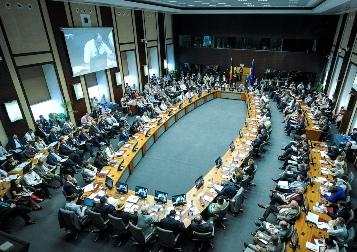
This year’s Security & Defence Agenda NATO conference, which took place on Friday 25 May 2012, gathered experts from across national, EU, NATO and private sectors to discuss the top policy priorities for the Alliance following the recently concluded Chicago Summit. Topics covered included the perceived ‘pivot’ of US foreign policy to the Asia-Pacific region, the reform challenges posed by the “Smart Defence” military equipment agenda and themes of financial austerity facing Europe.

Formal release of the Security Jam 2012 Report

The conference also provided a platform for the formal release of the Security Jam 2012 Report – the results and recommendations of the world’s largest online security and defence policy discussion. The Security Jam took place in March 2012.

The Hague Centre for Strategic Studies was one of the partners who contributed to the success of the 2012 Security Jam. Peter Wijninga and Joris van Esch, supported by Elsa Testelin, Sophie Roborgh and Tessa Ax, hosted the discussion on ‘Libya – Lessons learned’ and contributed an op-ed to the report.

New recommendations for European defence and security

The report details the top ten recommendations generated by this collaborative event, to which over 3,000 participants from 116 countries had their say. They include the need to focus on EU defence industrial policy, the possibility of forming a “NATO-China Council” in the mould of the current NATO-Russia model, and the suggestion of a country-wide public health and education scheme to help support Afghanistan after the 2014 NATO pull-out.

Participants at the conference strongly supported of the ideas and future targets presented in the report.

E.J. Herold, NATO’s Deputy Assistant Secretary General for Defence Investment, said that “this year’s report is even better than the first, and I am very enthusiastic about these recommendations – we hope such ideas will form the basis of what we at NATO will be doing in this post-Chicago summit period.”

Danish Permanent Secretary of State for Foreign Affairs Claus Grube, voiced views very much in line with the Jam recommendation of forming a NATO-China Council. “We should recognise that the rise of Asia carries enormous opportunities, as well as challenges. One such challenge will be to encourage China to communicate its vision of its place in global security – we should make sure NATO is still a relevant security partner here.”

To read the full report, please download the news PDF.

  • Share on Facebook
  • Share on X
  • Share on WhatsApp
  • Share on LinkedIn
  • Share by Mail

Experts

Related News

Related Content

2012 Security Jam Executive Summary
Strategy and Security 2012: The Margin of the Austrian Security Policy
Strategy and Security 2012:The Margin of the Austrian Security Policy

Office Address

  • The Hague Centre for Strategic Studies
  • Lange Voorhout 1
  • 2514 EA The Hague
  • The Netherlands

Contact Us

  • Telephone: +31(70) 318 48 40
  • E-mail: info@hcss.nl
  • IBAN NL10INGB0666328730
  • BIC INGBNL2A
  • VAT NL.8101.32.436.B01
  • Contact

Legal & Privacy

  • Disclaimer & Privacy
  • Algemene Voorwaarden 2024 (NL) 
  • Terms & Conditions 2024 (ENG) 
  • Algemene Voorwaarden 2026 (NL) 
  • Terns & Conditions 2026 (EN) 
  • Coordinated Vulnerability Disclosure
  • Ethical Standards
  • Manual for Responsible Use of AI

Follow us

© The Hague Centre for Strategic Studies
    Link to: Seminar on Opportunity, Risk and Conflict in the Global Struggle for Resources Link to: Seminar on Opportunity, Risk and Conflict in the Global Struggle for Resources Seminar on Opportunity, Risk and Conflict in the Global Struggle for Resour... Link to: Coherence in European Union External Policy before and after the Lisbon Treaty: The Cases of Energy Security and Climate Change Link to: Coherence in European Union External Policy before and after the Lisbon Treaty: The Cases of Energy Security and Climate Change Coherence in European Union External Policy before and after the Lisbon Treaty:...
    Scroll to top Scroll to top Scroll to top

    GDPR Consent

    Your privacy is important to us. Here you can set which consent you are allowing us with regards to the collection of general information, the placing of cookies of the collection of personal information. You can click 'Forget my settings' at the bottom of this form to revoke all given consents.

    Privacy policy | Close
    Settings

    GDPR Consent Settings

    Your privacy is important to us. Here you can set which consent you are allowing us with regards to the collection of general information, the placing of cookies of the collection of personal information. You can click 'Forget my settings' at the bottom of this form to revoke all given consents.

    Website statistics collect anonymized information about how the site is used. This information is used to optimize the website and to ensure an optimal user experience.

    View details

    Functional cookies are used to ensure the website works properly and are neccessary to make the site function. These cookies do not collect any personal data.  

    View details
    Forget my settings Deleted!